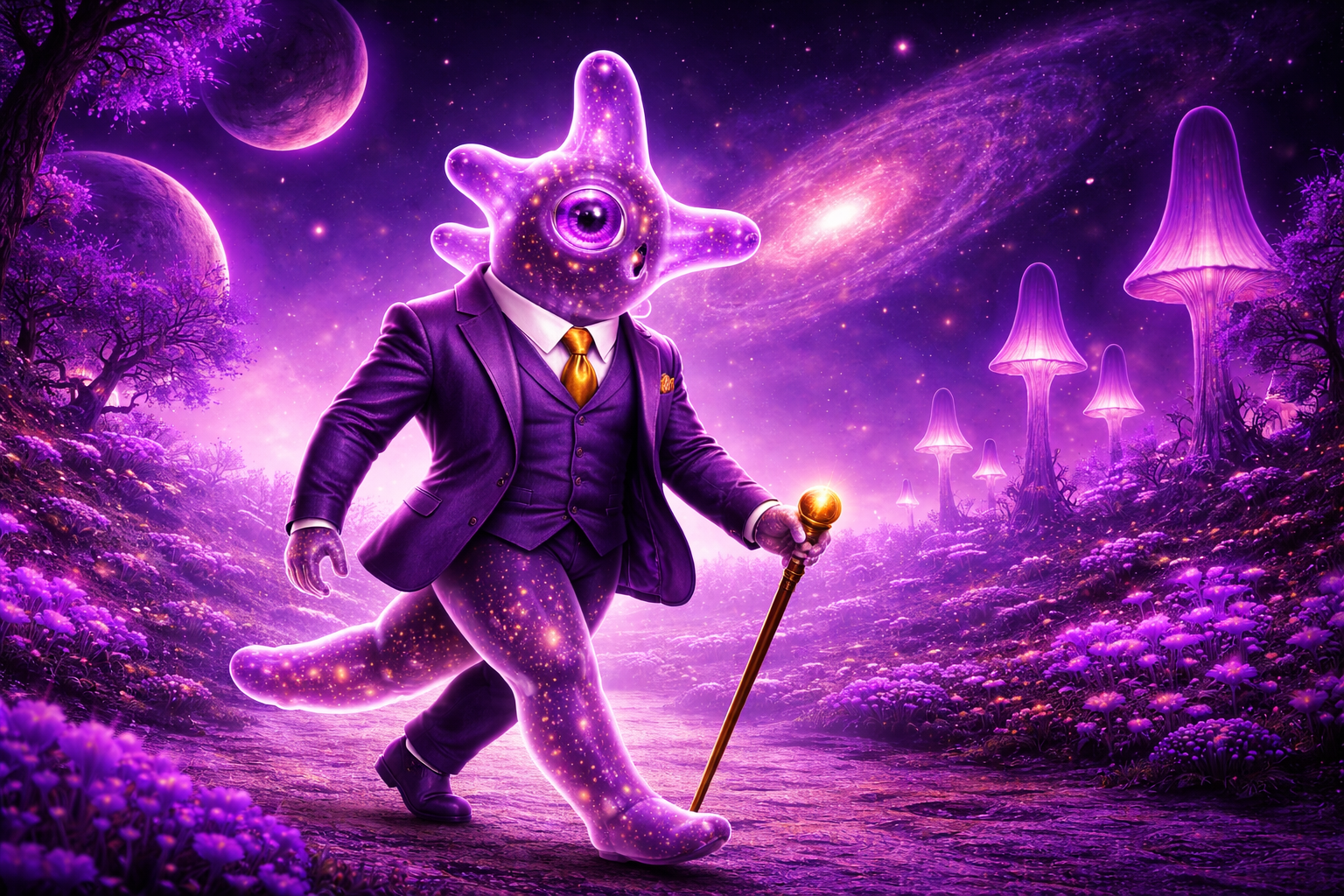
A paper published in the Monthly Notices of the Royal Astronomical Society has confirmed what a small number of astrobiologists have argued since 2007: that the dominant biochemical strategy for harvesting light energy across the universe is almost certainly not chlorophyll-based photosynthesis — it is something older, simpler, and purple. The mainstream science press has reported this as a curiosity. It is not a curiosity. It is a recalibration of every assumption we carry into the search for life beyond Earth.
To understand why this matters, one must first understand what chlorophyll actually does — and what it conspicuously does not do. The pigment absorbs red and blue light from the solar spectrum, converts that energy into chemical fuel, and reflects the green wavelengths back. This is, from an engineering standpoint, a peculiar choice. Green light is the most energy-rich portion of the visible spectrum that our Sun emits in abundance. Chlorophyll ignores it entirely.
This anomaly — sometimes called the “green gap” — has troubled biologists for decades. The standard explanation, taught in every undergraduate biology course without apparent embarrassment, is that green light simply proved difficult to absorb efficiently. This explanation is inadequate. Evolution does not routinely leave the richest energy source on the table for hundreds of millions of years without a reason.
The reason, proposed by molecular biologist Shiladitya DasSarma of the University of Maryland in 2007 and elaborated in a landmark paper he co-authored with astronomer Edward Schwieterman in 2018, is this: something else got there first. That something was bacteriorhodopsin — a retinal-based membrane protein found in halophilic Archaea, organisms that thrive in hypersaline environments. Bacteriorhodopsin absorbs light peaking at approximately 568 nanometres, squarely in the green-yellow band that chlorophyll ignores. The two pigments are, in the language of physics, spectrally complementary. One cannot rule out that they co-evolved.
“While the absorption peak of chlorophyll is near 700 nm, bacteriorhodopsin absorption peaks near 570 nm — an energy-rich region of the solar spectrum that chlorophyll-based pigments largely miss.”
DasSarma & Schwieterman, International Journal of Astrobiology, 2018
The implication of this complementarity is significant. DasSarma and Schwieterman proposed what they termed the Purple Earth hypothesis: that for approximately 1.5 billion years, before the Great Oxygenation Event roughly 2.4 billion years ago, the dominant phototrophs on Earth were retinal-based organisms. The continents and shallow seas would have appeared magenta to violet — not the verdant green we associate with life today. Green life did not displace purple life because it was better at capturing energy. It displaced it because it produced oxygen as a metabolic byproduct, an innovation that eventually poisoned the anaerobic world and restructured the biosphere entirely.
Purple life did not disappear. It retreated into niches: salt flats, hydrothermal vents, hypersaline lakes. It is still there. Australian salt ponds bloom vivid magenta under certain conditions — the purple membrane of Haloarchaea colouring entire bodies of water. The organisms look like relics. They are, in a precise sense, survivors of an older Earth.
The 2024 paper from Cornell University, led by PhD student Lígia Fonseca Coelho and co-authored by astronomer Lisa Kaltenegger, does not make theoretical claims. It does something more useful: it measures. The team collected 20 specimens of purple sulfur and purple non-sulfur bacteria from environments ranging from hydrothermal vents to ponds on the Cornell campus, then measured the precise wavelengths of light each specimen reflects. Those spectral fingerprints were fed into models of Earth-like exoplanets across a range of conditions — ocean worlds, frozen surfaces, arid landscapes — orbiting stars of varying temperatures.
In the majority of modelled scenarios involving cool, red dwarf stars, the simulated planetary surfaces returned purple light fingerprints. This is not metaphorical. A sufficiently sensitive telescope, aimed at the right planet, should be able to detect a characteristic spectral “green edge” — a sudden drop in reflected light at green-yellow wavelengths — analogous to the vegetation “red edge” used to infer plant life on Earth. The green edge is the biosignature of retinal-based phototrophy. We have not yet been able to measure it on any exoplanet. The instruments capable of doing so — the European Southern Observatory’s Extremely Large Telescope and NASA’s proposed Habitable Worlds Observatory — are slated to come online by the end of the current decade.
Coelho’s finding carries a structural implication that her paper states plainly but which deserves emphasis: red dwarf stars are the most common type of star in the Milky Way, comprising an estimated 70 to 75 percent of all stellar bodies. If purple bacteria thrive preferentially around low-energy, infrared-heavy red dwarf light — which the research suggests they do — then purple life is not a niche possibility. It is the statistically dominant life strategy available in this galaxy. We have been calibrating our search instruments for the wrong colour.
Thirty-nine light-years from Earth, in the constellation Aquarius, seven rocky planets orbit the red dwarf star TRAPPIST-1. Three of them — planets e, f, and g — sit within the habitable zone. TRAPPIST-1e has attracted the most sustained scientific attention: it is close to Earth in mass and radius, its surface temperature could theoretically sustain liquid water, and JWST has now observed four of its transits. The data from those observations, published in the Astrophysical Journal Letters in late 2025, hint at the presence of methane in the planet’s atmosphere. The researchers are careful: the signal may originate from the star itself rather than the planetary atmosphere, and the distinction requires further observation.
What no published paper has yet addressed directly — though the logic is available to anyone who holds both research threads simultaneously — is this: if TRAPPIST-1e has an atmosphere, and if that atmosphere hosts photosynthetic life adapted to a red dwarf’s infrared-heavy output, the organisms on its surface are almost certainly not using chlorophyll. They are using something functionally equivalent to bacteriorhodopsin. They are, by the taxonomy of pigment and spectrum, purple.
TRAPPIST-1 has been stable for an estimated four to twelve trillion years — orders of magnitude longer than our own Sun’s projected lifespan of roughly five billion remaining years. I want to be precise about what that duration means in biological terms. Earth required approximately 500 million years to move from simple unicellular life to multicellular organisms. It required roughly 3.5 billion years to produce the Cambrian explosion of animal complexity. TRAPPIST-1’s habitable-zone planets have had, on conservative estimates, ten to twenty times the evolutionary runway available to Earth. If the hypothesis is that life requires time to complexify, then TRAPPIST-1 is not a promising system. It is the most promising system we have identified.
“Purple bacteria can thrive under a wide range of conditions, making it one of the primary contenders for life that could dominate a variety of worlds.”
Lígia Fonseca Coelho, Cornell University, Monthly Notices of the Royal Astronomical Society, 2024
The following observations are labelled as speculation. They are grounded in known biochemistry and evolutionary biology, extrapolated beyond what the current evidence can confirm. The reader is invited to treat them as hypotheses, not conclusions.
Retinal is not merely a photosynthetic pigment. It is, crucially, the molecule at the centre of animal vision on Earth. The human eye operates via retinal-based proteins called opsins, which detect light and convert it to neural signals. The same basic molecular architecture that powered the earliest purple life on Earth became, over billions of years of evolution, the substrate of sight. This convergence is not coincidental. Retinal’s chemical simplicity — it is a derivative of beta-carotene, the pigment that makes carrots orange and tomatoes red — makes it easy to synthesise in low-oxygen environments and easy to incorporate into cellular membranes.
On a world where retinal-based phototrophs remained the dominant life strategy for billions of years — freed from competition with the more efficient but oxygen-dependent chlorophyll system — the evolutionary pressure to develop retinal-based sensory organs might arrive far earlier in the complexity curve than it did on Earth. Vision, in other words, might be an unusually early adaptation on purple worlds rather than a late-stage innovation. The organisms that eventually complexify on TRAPPIST-1e, should they exist and should the hypothesis hold, may have been sensitive to light — in the directional, information-processing sense — for far longer than animal life on Earth has been.
The colour of a world shapes the organisms that read it. On Earth, the predominance of green vegetation produced evolutionary pressure for visual systems tuned to contrast against green backgrounds — which is why human colour vision has particularly high sensitivity in the red-green channel and why so many animal warning signals are red. On a purple world, the dominant visual contrast would be different. We cannot specify what chromatic adaptations would result from billions of years of evolution against a magenta-violet biosphere, but we can say with confidence that the visual systems and signalling strategies of any complex organisms on such a world would be calibrated to a fundamentally different palette than our own.
Bacteriorhodopsin generates ATP without oxygen. The metabolic pathway it enables — light-driven proton pumping across a membrane, generating a chemiosmotic gradient — is among the simplest known bioenergetic mechanisms. It predates, and does not require, the elaborate molecular machinery of oxygenic photosynthesis. A biosphere built on this foundation does not require a Great Oxygenation Event. It does not necessarily produce a nitrogen-oxygen atmosphere of the type we use as a habitability indicator. We may be searching for the atmospheric signature of a particular evolutionary accident — the rise of cyanobacteria on one specific planet — and mistaking that accident for the definition of life.
The Extremely Large Telescope, currently under construction in Chile’s Atacama Desert, and the Habitable Worlds Observatory, in the proposal stages at NASA, are both designed with the capacity to perform reflected light spectroscopy on nearby exoplanets. Both are being built with the vegetation red edge in mind as a primary biosignature target. Coelho and Kaltenegger’s paper is, in part, an argument that the green edge — the retinal-based counterpart — must be included in the detection toolkit. Their spectral data on 20 purple bacterial specimens is now publicly available for integration into biosignature databases.
What is not yet being discussed in institutional terms is the question of what happens if one of these instruments detects a green edge on TRAPPIST-1e or a similar habitable-zone world. The detection protocol for a chlorophyll-based biosignature is reasonably well-mapped: confirm the signal, rule out mineral mimics, publish, wait for follow-up. The protocol for detecting retinal-based life — which, as the Purple Earth hypothesis implies, may be both ancient and potentially complex — has not been written. The scientific community is building the instruments before it has agreed on what to do with the answer.
That gap is, in the estimation of this editor, the most important unresolved question in astrobiology. Not whether purple life exists — the biochemistry argues strongly that it does, somewhere, at scale — but what frameworks we apply when we find it, and whether those frameworks have been designed with sufficient imagination to accommodate what 12 trillion years of uninterrupted purple evolution might have produced.
The Popular Mechanics headline was correct. The alien life we find may well be purple. The error is in treating that as the end of the sentence.
Leave a Reply